 MANDA
MANDA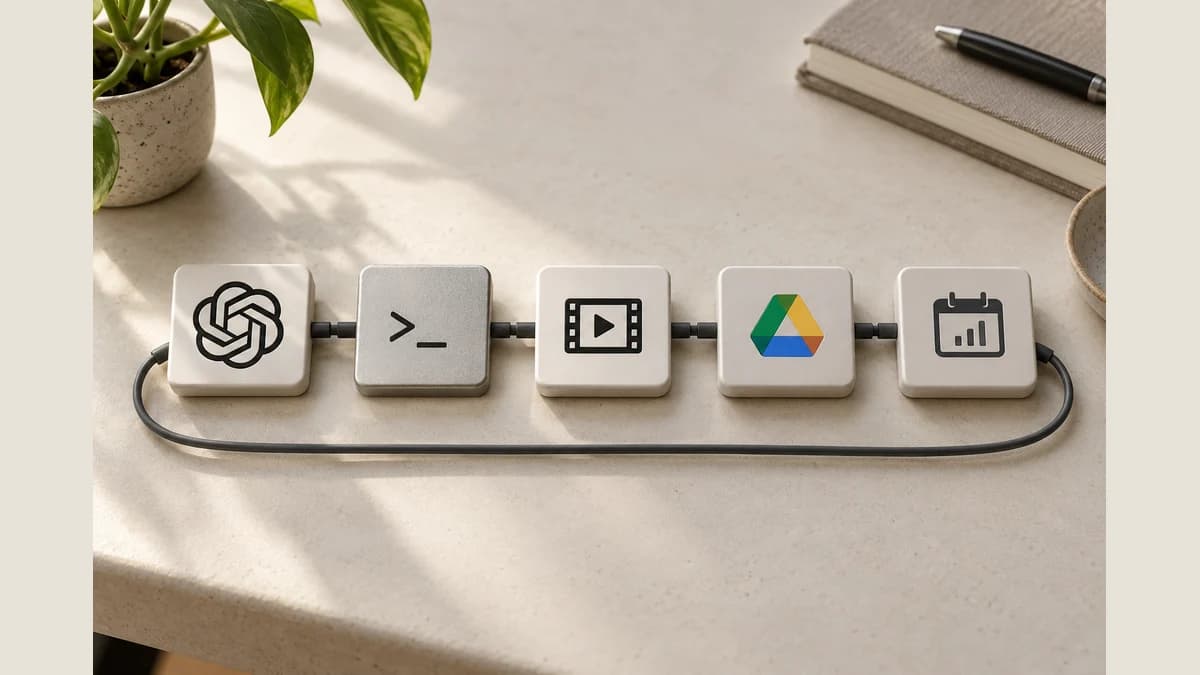
Automating AI Video Creation: My Creative Pipeline
Build notes — October 13, 2026. This system is still being improved. The cover is an AI-generated conceptual illustration, not a software screenshot.
To automate video creation with AI, I connected ChatGPT to Codex on my VPS through MCP. I describe an idea in the conversation. Codex prepares a script, proposes an art direction and orchestrates a HyperFrames composition with voiceover, music and sound effects. A separate agent examines the rendered output and requests corrections when needed.
My computer does not need to stay on during processing: the work runs on the server. I retain two important creative decisions, approving the key images and approving a short animated preview.
The project started with a practical annoyance. I developed ideas in ChatGPT, then copied prompts into Codex to make the video. I wanted to remove that manual handoff while keeping creative freedom and the ability to judge the result.
From an idea to a rendered video
This is the intended journey through the system. Creative approvals remain human decisions; production and bounded correction cycles run on the VPS.
- I describe an idea in ChatGPT. A message, story, mood or optional reference provides the starting point.
- MCP hands the request to Codex. The server keeps an identifiable job whose progress can be checked later.
- Codex develops the script and art direction. Three key images make the proposal tangible before animation starts.
- I approve the images, then a five-second preview. This tests the visual language, movement and atmosphere before the full film.
- HyperFrames builds the composition. Illustrations, text, transitions, narration, music and sound effects are assembled.
- An independent agent reviews the output. Findings go back to the creator for corrections, another render and another review.
- The approved file is delivered to Google Drive. Retrieving it from ChatGPT and scheduling it through Metricool is the next integration to validate end to end.
“Autonomous” describes execution between my approvals. It does not mean publishing without permission or guaranteeing that an AI will produce flawless work.
Why connect ChatGPT to Codex through MCP?
In this project, ChatGPT is the conversational interface. Codex works in the environment containing the project files, creative instructions and rendering tools. MCP provides the connection for submitting a request and reading its status without manually moving the brief between applications.
The main objective is continuity of information. A copied prompt may leave behind approved images, audio constraints, earlier feedback or delivery status. The pipeline keeps those elements with the ongoing job.
It also changes how progress is checked. When I ask where the video stands, the system should find the existing request. It should not interpret a status question as an instruction to generate another video. That distinction helps avoid unnecessary competing versions.
What do the agents share?
The creator receives the intended message, format, duration, constraints and approved art direction. The reviewer receives the output and the acceptance criteria. Review findings return to the creator as specific, actionable problems.
“Make this more professional” leaves considerable room for interpretation. “The sheet appears abruptly instead of coming out of the folder” identifies an observable defect. “The hand does not match the approved illustration style” identifies a concrete inconsistency. A handoff is useful when it explains what should change in the next version.
This separation follows the approach described in my article on agentic AI in business: assign clear responsibilities, preserve context and define stopping conditions.
Create from an idea without copying a Reel
A reference can communicate timing, texture or emotion. It should remain optional. I have therefore included several starting points in the creative workflow: an original idea, a short story, images, a sound concept, mixed references or a request for an original proposal.
This example illustrates the kind of brief the system is intended to accept:
Create an 18–20 second Reel explaining three repetitive tasks a freelancer can automate. Use a simple visual metaphor, a warm atmosphere, French narration and lively movement. Propose an original art direction and show the key images before producing the complete animation.
The brief specifies a message and an intention while leaving room for a short story, a transforming object, a demonstration or a typographic composition. A product launch may need a different treatment from an educational explanation. Creative instructions should support those choices rather than force every topic into one template.
Art direction needs visible evidence
Our early renders exposed the limits of words such as “modern,” “premium” and “dynamic.” A video could meet technical requirements and still feel generic. We added a stage where the proposed art direction becomes visible before committing to the full animation.
The three key images make it possible to assess palette, materials, proportions, hierarchy and illustration style. Once approved, they become the reference for subsequent work. A correction agent should not quietly replace the concept to solve a technical problem.
One experiment used the metaphor of a desk organizing itself, with tactile paper and blue accents. That direction belongs to that film. It is not a universal template for future projects.
Bringing motion design, voice and music together
HyperFrames handles composition and animation in this workflow. The goal extends beyond displaying a succession of pictures with captions. Entrances, exits, scale changes and transitions should support the narration.
There are three distinct audio layers. Voiceover communicates the explanation. Background music establishes energy and continuity. Sound effects emphasize selected movements or transitions. Adding a sound to every action can distract from the message rather than improve it.
Timing should follow the actual recorded narration. A sentence should not be cut short to fit a scene boundary chosen before the voice was generated. The visuals can evolve while the sentence continues, with a transition placed at a natural pause.
The five-second preview tests these choices together. A strong still image can become awkward in motion. A soundtrack can be present in the file and still sound monotonous. Preview approval is therefore a creative decision, not just a file check.
What independent review can actually check
The reviewer examines frames extracted from the rendered video, not only instructions or composition code. Technical inspection covers the output file, dimensions, duration and expected media elements. Visual review looks for readability issues, overlaps and inconsistencies with the approved images.
Illustrations require particular care. A malformed hand, floating object, inconsistent shadow or sudden appearance can break the visual impression. In our experiments, passing technical checks did not prevent human feedback about an odd-looking hand and music that needed improvement.
Corrections have a defined limit
When a defect can be corrected, the system preserves the review evidence, sends the findings to the creator, renders again and requests a fresh review. The cycle allows at most two repair passes. If the issue persists, delivery stops with the available evidence retained for diagnosis.
This prevents an endless loop consuming resources without resolving the underlying problem. A connection failure, uncertain result or unavailable dependency also does not justify blindly repeating a potentially paid operation.
Job state is saved so the current step can be tracked. Some interruptions can be resumed without creating a new request. Other situations still require intervention. Recovery has a defined scope; it is not a guarantee that every failure can be resolved automatically.
Technical approval cannot replace taste
An agent may detect an overlap more reliably than it can judge whether a scene lacks personality. Human listening also matters: measuring loudness does not establish whether the music suits the piece.
I retain creative approval and use human feedback to improve the instructions. The system should reduce repetitive handling while leaving space for artistic judgment. A review report is useful evidence, but it does not remove the need to watch the actual output.
A VPS for production and Google Drive for delivery
Processing runs on a remote server. My computer can be switched off during generation because rendering does not depend on the local session. The server services and required connections must remain available. Remote hosting alone does not guarantee that every service will recover after a server restart.
Google Drive provides private delivery for files that pass the configured checks. Approval applies to the version that was reviewed; a correction requires a new review. A file merely existing is not sufficient evidence that it is ready.
For social distribution, the intended next step is to retrieve the delivery from ChatGPT and prepare scheduling through the Metricool MCP connection. That complete handoff has not yet been validated. I am not presenting automatic social publishing as an already working outcome.
What works and what still needs improvement
At the time of these build notes, the ChatGPT-to-VPS connection, art-direction stages, preview production, independent review and private delivery have been implemented. A corrected preview has gone through the repair loop and reached Drive for human approval.
Work continues on illustration quality, movement consistency, the soundtrack and transport reliability between tools. The complete film for this experiment is not presented here as an approved final result. I am also not claiming a measured time saving or average cost per video: those figures require several comparable productions.
The useful outcome is a system in which the brief, creation, review and delivery share the same context. It can provide a foundation for educational content, feature presentations and editorial Reels, with creative requirements appropriate to each use case.
FAQ
Does ChatGPT edit the video in this system?
ChatGPT is the interface for communicating the idea and checking progress. Codex orchestrates work on the VPS, while HyperFrames produces the composition. The output depends on that configured workflow, not the conversation text alone.
Do I need to provide a Reel reference?
No. An idea, message, story or mood can be enough. References are optional and communicate intent rather than require a copy of another video.
Does everything happen without human intervention?
Production and bounded corrections run between creative approvals. I approve the key images and then the animated preview. Failures outside the recovery scope may still need diagnosis.
Is this a free AI video generator?
No. It is a custom pipeline using a server and generation services whose costs depend on usage. No reliable per-video cost is claimed at this stage.
Are videos already published automatically through Metricool?
No. Private Drive delivery and social scheduling are separate stages. The complete retrieval and scheduling journey through Metricool remains to be tested.
Build around your own content workflow
A useful starting point is an example of the content you want to produce, together with brand constraints and acceptance criteria. Those inputs help determine what can be automated, what needs checking and what should remain a human decision.
You can also explore my approach to development with AI agents. To discuss a workflow for your business, tell me how you currently create and review content.