 MANDA
MANDAInternational Opportunity Agent
RSS monitoring, AI qualification and human-approved outreach
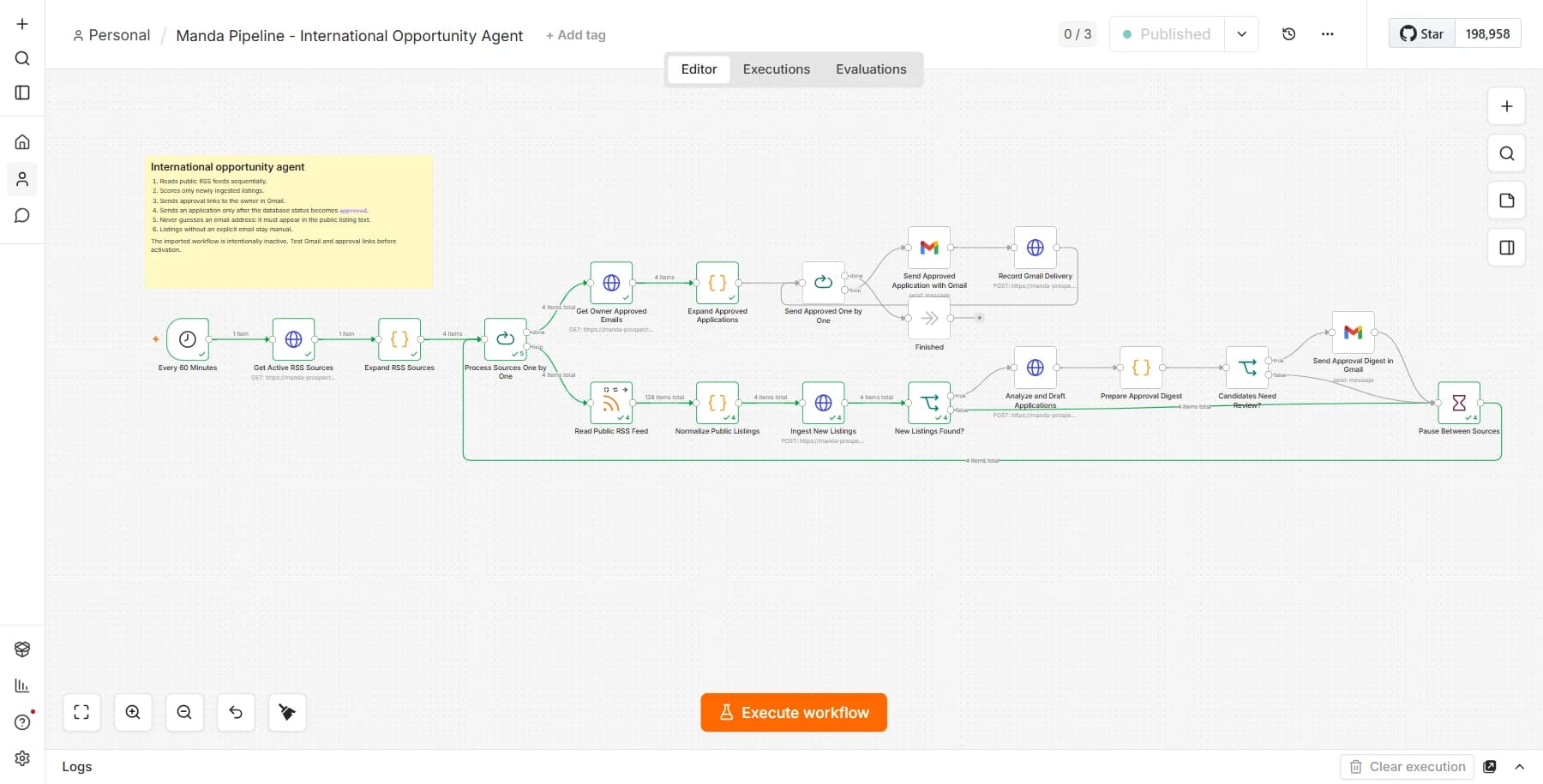
An assisted prospecting system built to detect relevant international contracts without turning applications into blind automated outreach. Every 60 minutes, n8n reads four public RSS sources, normalizes listings and deduplicates them in PostgreSQL. New opportunities are scored with deterministic business rules, then analyzed through OpenRouter when they reach the useful threshold. The strongest matches arrive in Gmail with a concise brief, a tailored draft and two expiring links: approve or reject. An application can only be sent after human approval and only when the public listing explicitly contains a contact email. Everything else remains a manual application. The workflow includes an AI fallback model, retry paths, a decision history and a delivery record for every Gmail send.
Human-approved prospecting
Finding the right contracts without automating trust
This agent turns several international opportunity feeds into a short, actionable decision queue. n8n orchestrates collection, PostgreSQL removes duplicates, business rules filter noise and OpenRouter analyzes only the listings worth deeper review. Gmail then becomes the approval interface: no application leaves the system until I explicitly approve it.
- Cadence
- one execution every 60 minutes
- Sources
- 4 public RSS feeds processed sequentially
- Observed run
- 128 listings read in one complete cycle
- Safeguard
- human approval and public email required
Four international sources, one operating format
The workflow monitors public feeds focused on remote contracts, engineering, AI and full-stack development. Sources come from the application's configuration and are read one at a time, so a slow or failing feed cannot block the entire cycle.
Every listing is normalized into the same structure: source, role, company, location, date, URL, description and any explicitly public contact details. The backend stores a PostgreSQL fingerprint before expensive analysis, preventing the same opportunity from consuming model credits twice.
Hybrid scoring reserves AI for stronger signals
The first qualification layer is deterministic. It measures technical fit, contract or freelance intent, remote compatibility and exclusion signals. Only listings that reach 55/100 move to AI analysis, keeping cost controlled and pipeline behavior predictable.
OpenRouter uses Qwen as the primary model and Gemini Flash Lite as fallback. The model returns strict JSON covering fit, evidence, risks, an application angle and a draft. If both models fail, the system keeps the business score and a deterministic fallback instead of losing the opportunity.
Gmail acts as a lightweight approval interface
At 75/100, an opportunity enters a Gmail digest containing what is needed for a fast decision: source link, summary, score, reasons and proposed message. Two signed links, valid for 48 hours, allow the owner to approve or reject without opening the technical dashboard.
Approval does not bypass contact rules. Automatic outreach is possible only when the public listing explicitly contains an email address. The system never guesses addresses. Without a public contact, the listing remains flagged for a manual application on the original platform.
Automation designed to be operated
Sources run sequentially with a controlled pause, critical calls have recovery paths and every decision is persisted. Approved applications are sent one at a time, then Gmail delivery is recorded to prevent duplicate sends and keep the journey auditable.
One observed full execution processed four sources and 128 listings. A second pass ingested no duplicates, validating the least visible but most important behavior of the system: knowing when there is nothing new to do.
Remote n8n automation consultant
Reliable n8n workflows, API integrations, error recovery and production support for remote teams.
AI automation consulting
Apply AI to measurable operations while keeping sensitive decisions under human control.
Codeur.com opportunity pipeline
The earlier local pipeline for collection, explainable scoring and human review.
Sales automation showcase
Seven hands-on n8n demonstrations covering prospecting, content and lead qualification.
Does the agent automatically apply to every listing?
No. It filters and prepares the strongest opportunities, but sending requires explicit human approval. Listings without a public contact email remain fully manual.
Why combine business rules with an AI model?
Rules remove noise quickly with predictable behavior. AI then works on a smaller set to understand context, explain fit and prepare a tailored draft.
How does the system prevent duplicate applications?
Every listing receives a fingerprint stored in PostgreSQL. Decisions, approvals and delivery results are persisted, preventing an already processed listing from returning as a new opportunity.
Can this architecture support a sales team?
Yes. Sources, criteria, thresholds, models and approval channels can be adapted to sales leads, tenders, partnerships or inbound requests.