 MANDA
MANDATeamIA prospecting automation with Lemlist and n8n
Custom prospecting software, AI qualification and human review
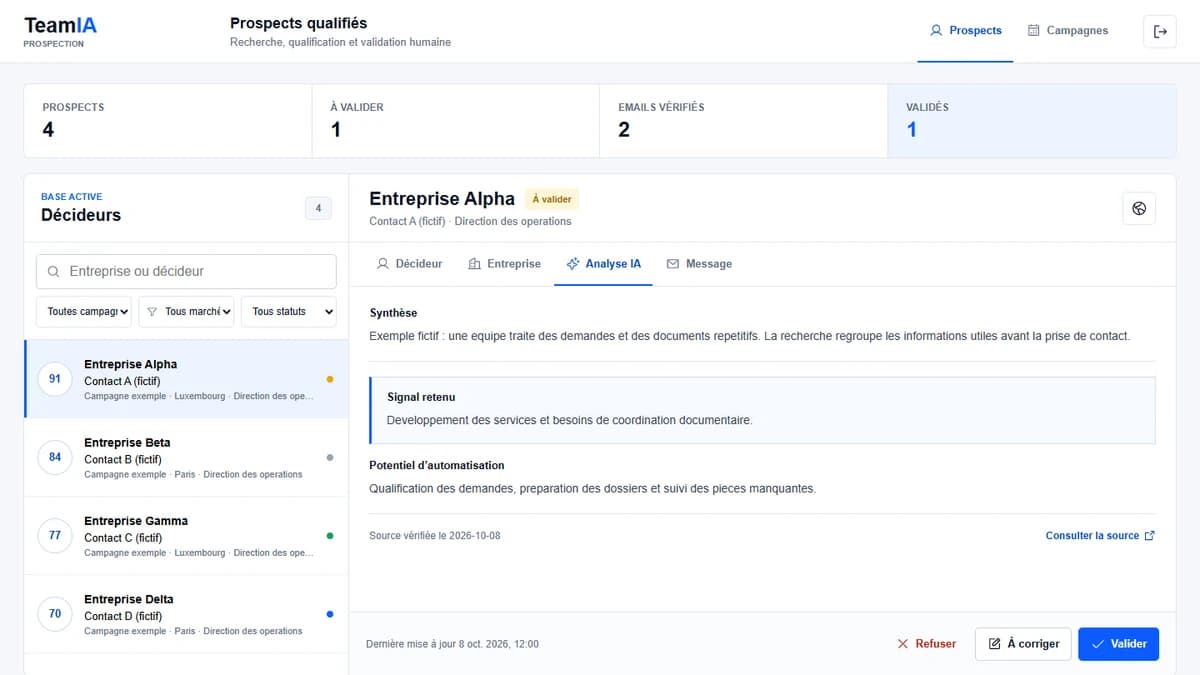
Designed and built TeamIA’s private B2B prospecting dashboard: campaign and segment settings, ingestion of prospects enriched through n8n and Lemlist, search and filters, AI research, message editing and human review. The Next.js and React application uses PostgreSQL/Supabase, ingestion APIs and company deduplication. Screenshots show the real interface with fictional data. Approval saves a decision and does not send an email.
Client case study · Business application & automation
From prospect research to a documented sales decision
TeamIA Prospection is a custom B2B prospecting application connecting campaign settings, data prepared by n8n and Lemlist, and human review. The team can inspect the company, decision maker, AI research and proposed message in one workspace. Reviewers can edit the draft, request changes, approve or reject the prospect. Approval records a decision; it does not send an email.
- Deliverable
- Prospecting dashboard and business API
- Stack
- Next.js · React · PostgreSQL/Supabase · n8n · Lemlist
- Review process
- 5 statuses, from enrichment to approval or rejection
- Initial scope
- Segmented campaigns for Paris and Luxembourg
The requirement: manage multiple campaigns without losing context
TeamIA needed more than a contact list. Each campaign had its own offer, targeting rules, decision-maker roles, exclusions and messaging instructions. Once enrichment completed, a reviewer still needed to understand why the company was relevant and whether the proposed message was usable.
I built the review interface, campaign and segment configuration, prospect ingestion APIs and persistence of review decisions, connected to the n8n engine. The resulting workspace gives the team an actionable queue without requiring it to inspect individual automation executions.
Campaign settings built around the team's prospecting rules
Campaigns can be draft, active or paused. Their settings include the offer, target pain points, included and excluded job titles, and message instructions. Segments specify country, location, industries, company size and quotas. These settings feed the workflow instead of remaining scattered across automation nodes.
The inspected implementation caps active campaigns at ten prospects per day in total. This is an operating limit for the initial scope, not a throughput benchmark. Segment pagination supports continued research; future scaling must account for provider quotas and the team's review capacity.
AI lead qualification that a reviewer can inspect
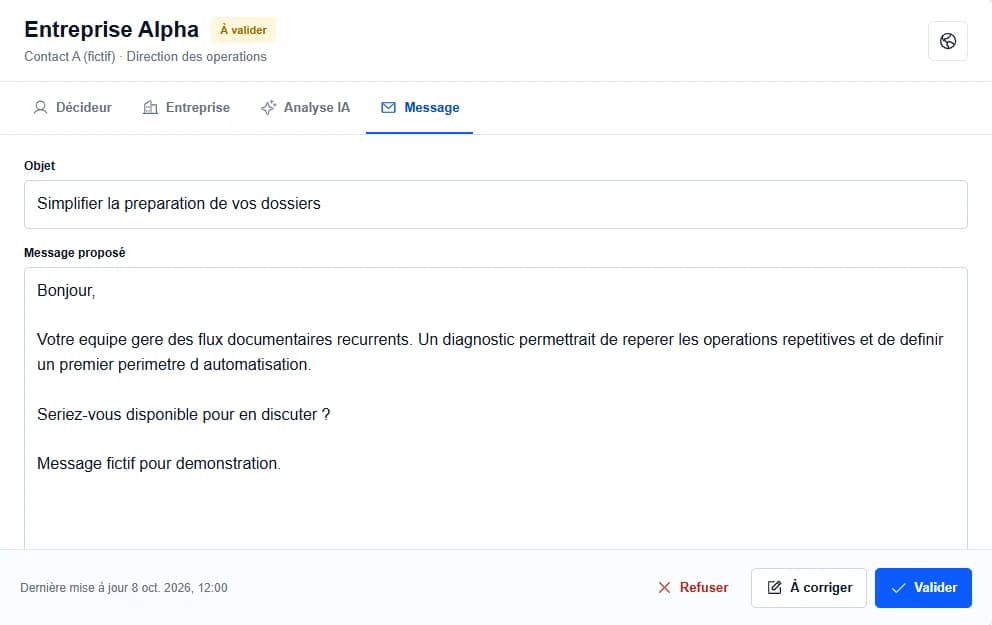
Each prospect has four views: contact, company, AI analysis and message. They bring together the company score, contact information, email status, recorded technologies, research summary and suggested automation opportunity. Filters narrow the queue by campaign, market and review status.
Research signals have source URL and date fields, giving reviewers context for checking the proposed approach. The score prioritizes review; it is not a predicted conversion rate. AI summaries and verification labels still require judgment before the information is used for outreach.
Connecting Next.js, n8n, Lemlist and Supabase
Next.js and React provide the dashboard and API routes. PostgreSQL on Supabase stores campaigns, segments, processed companies and prospects. n8n reads active segments and orchestrates research and preparation; Lemlist supplies the company search and enrichment capabilities used by that pipeline.
An ingestion API accepts normalized results, validates inputs on the server and links returning data through a prospect deduplication key. Browser access and automation requests use separate authentication mechanisms. Integration secrets and the PostgreSQL connection remain server-side.
Deduplicating companies before further enrichment
The system derives a company key from its normalized domain or an available identifier. It reserves selected companies in the database, where a uniqueness constraint and conflict-safe insert exclude previously processed accounts before new decision-maker research.
Company reservation and pagination progress are committed together in a transaction. Prospect ingestion has its own deduplication key. These boundaries address separate needs: avoiding repeated company research and attaching enrichment to the right contact. They make recovery more controlled without implying every provider failure is automatically resolved.
Human approval is a product feature
Prospects have explicit states: awaiting enrichment, to review, approved, changes requested or rejected. Reviewers can edit the subject and message body and leave a comment. A review action persists the status, draft and comment to the prospect record.
Approval does not mean delivery. The presented dashboard contains no prospect-email sending action. Connecting an outbound tool would be a separate scope, with suppression rules, frequency limits and explicit approval conditions.
Delivered functionality and measurement boundaries
The deliverable connects campaign configuration to prospect review, with persistent decisions and accessible supporting information. Screenshots show the real interface populated exclusively with fictional companies, contacts and messages. Neither a client prospect list nor access to the private dashboard is published here.
No verified time savings, meeting counts or attributed revenue are claimed. Useful operational measures would include excluded duplicates, enrichment cost per usable record, review time and the proportion of corrected or approved drafts. Commercial outcomes require separate tracking after outreach.
Planning a custom prospecting application
This approach suits B2B agencies and sales teams with specific targeting criteria, multiple offers and a need to review AI-prepared messages. Discovery starts with permitted data sources, qualification rules, existing tools and ownership of the review process.
An initial version can cover one campaign, one enrichment path and a review queue. Volumes, access rights, CRM integrations and any sending functionality should then be scoped against real constraints. A concrete campaign and its current process provide a useful starting point for a custom prospecting project.
The n8n and Lemlist workflow
Explore the sourcing and enrichment engine behind the dashboard.
The TeamIA platform
See the client's business website and wider ecosystem.
Custom application development
Connect your business rules to an interface and relevant integrations.
Scope your prospecting tool
Define data sources, targeting criteria and your review process.
What is custom B2B prospecting software?
It is an application built around a team's targeting rules, data sources and sales process. For TeamIA, it connects campaign settings, n8n/Lemlist enrichment and human review in one dashboard.
How is it different from a CRM or Lemlist alone?
The dashboard implements TeamIA-specific configuration and review rules. Lemlist supports search and enrichment. The application does not replace a complete CRM: its scope is preparing and approving prospects before downstream sales follow-up.
How does AI help qualify leads?
The pipeline prepares research, a business signal, an automation opportunity and a message draft. The dashboard makes this information available for review. Its presence is not a guarantee of accuracy or conversion.
Are messages sent automatically?
No. Review actions save a decision and message edits. Automatic sending is outside the scope of the presented dashboard.
Is a public demo available?
This page shows the real interface with fictional data. The client dashboard and prospect data remain private. A guided demonstration can be discussed when scoping a similar project.