 MANDA
MANDATeamIA
AI agent and business automation platform
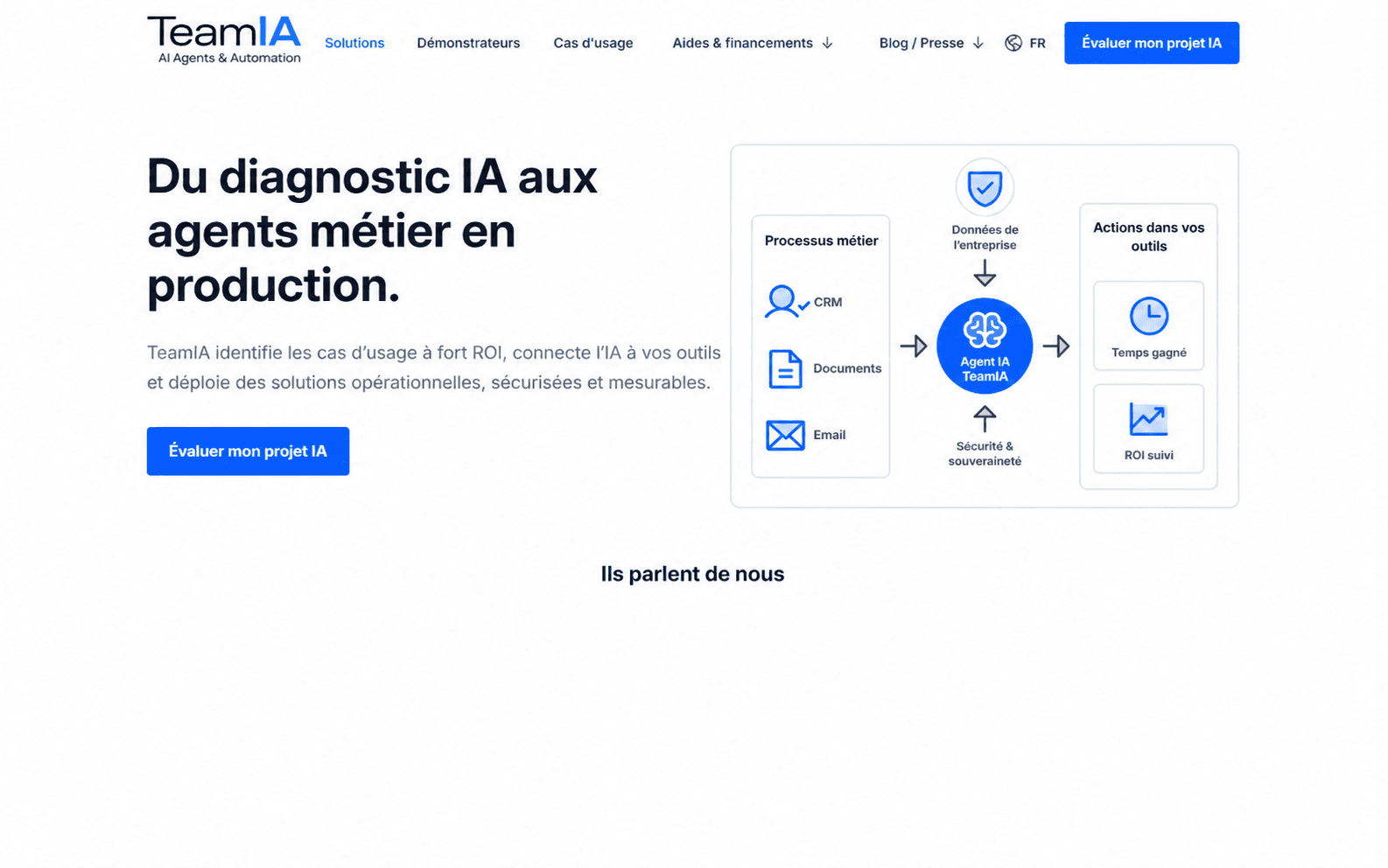
Complete strategic, UX and technical redesign of TeamIA, an AI agent integrator operating in France and Luxembourg. The project began with reverse engineering of the previous Webflow site, an SEO/GEO audit and a sharper market position. I then designed the visual direction, content architecture and Next.js platform connected to Payload CMS, PostgreSQL/Supabase, n8n and Resend. The website brings together local market pages, interactive AI agent demos, use cases, funding guidance, press coverage, a multilingual blog and a secure business enquiry flow. Public content has a static fallback so the site remains fast and available when the CMS is temporarily unavailable.
B2B AI platform redesign
Turning a Webflow website into an operational platform
TeamIA needed to move from a broad showcase website to a platform that could explain, demonstrate and sell business AI agents in France and Luxembourg. I handled reverse engineering, positioning, UI/UX direction, the Next.js and Payload CMS architecture, Supabase and n8n integration, and the SEO/GEO migration. The result is a measurable multilingual content system designed to remain available even when the remote CMS is unavailable.
- Scope
- strategy, design, engineering, CMS and acquisition
- Stack
- Next.js 16, Payload CMS 3 and PostgreSQL
- Automation
- forms and 9 demos connected to n8n
- Markets
- France, Luxembourg and FR/EN/DE content
Positioning before interface design
The previous website presented many AI capabilities without a strong hierarchy between diagnosis, integration and business outcomes. The work started with reverse engineering of the pages, messages, journeys and trust signals. The goal was not to repaint Webflow, but to define what TeamIA should represent to an SME decision-maker.
The selected position presents TeamIA as a cross-border integrator that turns a business process into an operational, measurable and fundable AI agent. The journey now connects two stages: frame the use case, then deploy the agent and measure value. France and Luxembourg remain local entry points without forcing an IP-based redirect.
UI/UX designed to reassure B2B decision-makers
Several full-page directions were explored before consolidating a clear and operational interface. The first viewport delivers one promise, one primary action and one readable system diagram: data and processes enter a secured agent, then produce tool actions, time savings and measurable ROI.
The rest of the page prioritizes the journey, demos and evidence. Press coverage, founder profile, local markets, FAQ and contact each have a defined role. Icons, typography and component dimensions are normalized so the team can extend the website without losing visual coherence.
Next.js and Payload CMS without runtime dependency
The frontend was rebuilt with Next.js while Payload CMS manages pages, articles, markets, funding programs, use cases, demos, FAQ, team, press and redirects. PostgreSQL on Supabase stores structured content and separate object storage hosts media.
Remote Payload reads are intentionally optional for the public site. A static snapshot acts as a fallback: if the database or CMS is unavailable, marketing pages continue to respond without opening a PostgreSQL connection on every visit. This improves availability, speed and Vercel/Supabase quota control.
n8n demos protected by a server boundary
The nine demos never call webhooks directly from the browser. A Next.js route validates the request, applies limits and relays it to n8n with a server-only secret. The contact form follows the same boundary before persistence and workflow delivery.
This separates the visible experience from credentials and orchestration. Logging, volume controls, retries and workflow changes can evolve without exposing the n8n instance or coupling the frontend to technical implementation details.
An SEO/GEO migration managed URL by URL
The redesign preserves existing domain authority through a migration matrix covering source URL, destination, redirect, canonical and language equivalent. Native pages replace hard-to-index embedded content, with sitemap, hreflang, metadata, structured data and files readable by AI agents.
France, Luxembourg and Paris hubs address distinct local intent. Articles, market pages, use cases and demos are connected by topic to avoid orphan pages. GA4, GTM and PostHog remain consent-aware, enabling journey measurement without loading optional tracking before the visitor's choice.
A platform that can be operated after launch
The delivery includes Payload migrations, static content fallbacks, admin scripts, Supabase procedures, access security and operational documentation. Production accounts, source code, data and essential services belong to TeamIA to prevent provider lock-in.
This case study combines my complete business website approach: understand the offer, design the journey, build the editorial system, connect operations, preserve search equity and document maintenance. Launch is the beginning of a measurable content and conversion improvement loop.
Visit TeamIA
Explore the live platform, markets, AI demos and business content.
Website and SaaS development
Next.js products, content architecture and integrations for business platforms.
n8n automation consultant
Secure webhooks, documented workflows, retries and human approval paths.
SEO and GEO consulting
Search architecture, useful content, structured data and AI search visibility.
What was the primary objective of the TeamIA redesign?
To move TeamIA from a broad AI catalogue to a B2B platform with a clear journey: identify a use case, deploy an agent connected to business tools, secure its actions and measure the outcome.
Why combine Next.js and Payload CMS?
Next.js provides rendering, performance and SEO control. Payload offers structured administration for pages, articles, markets, demos and evidence. A static fallback prevents public pages from depending on a CMS query for every visit.
How are TeamIA demos secured?
The browser calls a Next.js server route. It validates the request and then contacts the n8n webhook with a secret that is never exposed to the client. Limits and error paths reduce abusive or incomplete calls.
Does the redesign preserve the previous site's search visibility?
Yes. A migration matrix maps legacy URLs to new pages and controls redirects, canonicals, hreflang and sitemap entries. Content is also organized into local and topical hubs rather than isolated pages.
Can TeamIA edit the website without a developer?
Yes for content modeled in Payload: pages, articles, FAQ, markets, press, use cases and demos. Components and section types remain governed to preserve UI/UX and engineering quality.