 MANDA
MANDA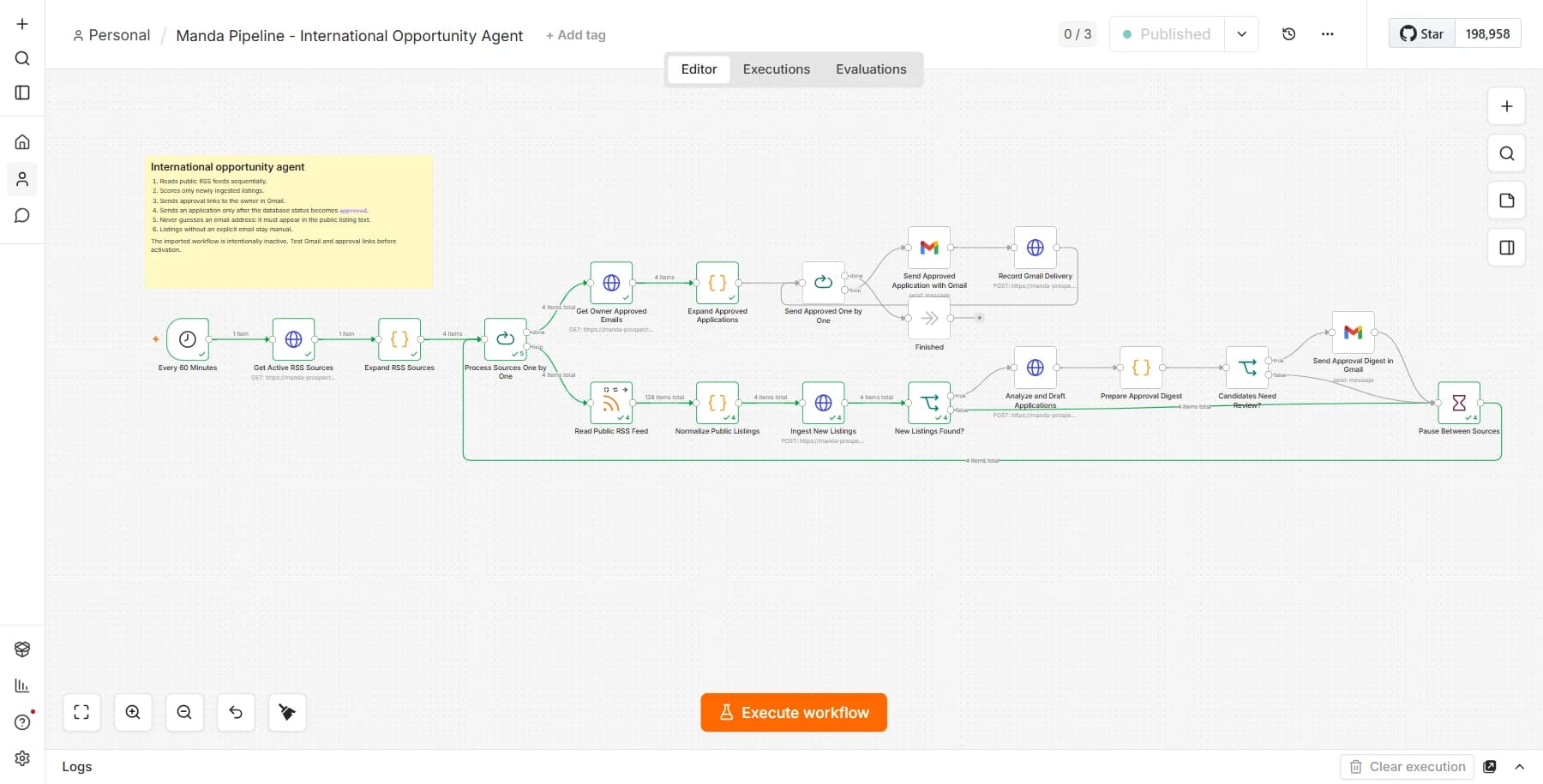
AI Prospecting Agent: Qualify Leads Without Automating Spam
A prospecting agent is not an email blasting machine
A useful AI prospecting agent does not try to contact as many people as possible. It collects permitted signals, cleans the data, measures ICP fit, prepares context and helps a salesperson decide which opportunity deserves attention.
This changes the architecture. If the objective is sending hundreds of messages, AI mainly increases noise and risk. If the objective is shortening the time between a relevant signal and a human decision, it becomes a valuable sales tool.
What can an AI prospecting agent do?
Collect signals
The system can receive forms, Facebook messages, email replies, CRM exports, RSS feeds or public opportunities. Every source needs an allowed use and preserved provenance.
Normalize and deduplicate
The same company can appear under different names, domains or contacts. The workflow standardizes fields, checks identifiers and prevents duplicate records.
Enrich only useful fields
Enrichment may add industry, size, country, role or relevant public information. It should not become unlimited collection of personal data. Each field must support an explainable commercial decision.
Score ICP fit
Stable rules first evaluate objective criteria such as market, need, technology, known budget, location or urgency. AI then handles ambiguous text by summarizing the request or identifying a business pain.
Prepare the next action
The useful output is not just a score. The agent provides reasons, missing information, a response angle and a recommended action: reply, clarify, wait or reject.
Architecture of a controlled prospecting pipeline
A reliable pipeline usually follows seven steps:
- receive the signal and preserve its source;
- validate and normalize fields;
- check duplicates in the CRM or PostgreSQL;
- apply deterministic business scoring;
- use AI only after a meaningful threshold;
- create a draft and request approval;
- update the CRM after the decision or response.
n8n orchestrates movement between tools. The model interprets text while rules, permissions and approval remain explicit.
Real example: monitoring international opportunities
My international opportunity agent built with n8n monitors public feeds, normalizes listings and removes duplicates in PostgreSQL. Business rules filter noise before OpenRouter analyzes only the candidates that cross the first threshold.
The strongest opportunities reach Gmail with a summary, scoring reasons and a draft. Nothing is sent without human approval. When a listing does not include a public contact address, the system keeps it for a manual application on the source platform.
The same design applies to inbound leads: replacing opportunity feeds with Facebook, forms or a CRM does not change the control principles.
Building an explainable score
A commercial score should be explainable in one sentence. Several visible criteria are better than an opaque score produced entirely by a model.
For example, add points when the need mentions n8n, automation, remote contract work or API integration; subtract points for a clear skill mismatch; and trigger AI analysis only above a defined threshold.
Weights improve through real decisions. A rejected lead with a high score becomes evidence for adjusting the rules.
Metrics that matter
Lead volume alone is insufficient. Measure the share of genuinely qualified cases, decision time saved, false positives, response by source, qualified-to-meeting conversion, duplicates avoided and average analysis cost.
PostHog or the CRM can measure the website journey while n8n records workflow decisions. Keep those populations separate: a page view is not yet a lead, and a technical event is not necessarily a person.
Required safeguards
Human approval
Promises, pricing, applications and sensitive messages should be reviewed before sending, especially while the scoring system is still learning.
Immediate stop conditions
The workflow must stop after a reply, rejection, unsubscribe or invalid address. Blind follow-up destroys trust.
Minimal data
Keep only required data, document its source and limit retention. Technical enrichment does not remove obligations around data and outreach.
Traceability
Store the source, rule version, score, reasons, approval and outcome. Without history, the system cannot improve responsibly.
AI agent or classic automation?
Duplicates, thresholds, status changes and routing rules belong to classic automation. Summarizing a need, classifying text and preparing an angle may benefit from AI.
The strongest system uses AI inside a workflow, not instead of one. Explore the AI prospecting agent solution to see how qualification, CRM, drafts and controlled follow-up connect.
FAQ
Can an AI agent send prospecting emails automatically? Technically yes, but automated delivery should be enabled only for an authorized, tested and explainable journey. Human-approved drafts are a safer starting point.
Do I need a large contact database? No. A small volume of relevant, documented signals close to the ICP usually supports better decisions than a large poorly qualified list.
Which tools work with n8n? It depends on the existing CRM and sources. PostgreSQL or Supabase can handle deduplication, approved providers can enrich fields, and Gmail can provide a lightweight approval interface.
How do you prevent hallucinated information? Provide verified data, require structured output, prohibit unsourced fields and keep human approval when confidence is low.
Want to qualify leads without industrializing noise? Send me your sources, ICP criteria and current journey.